
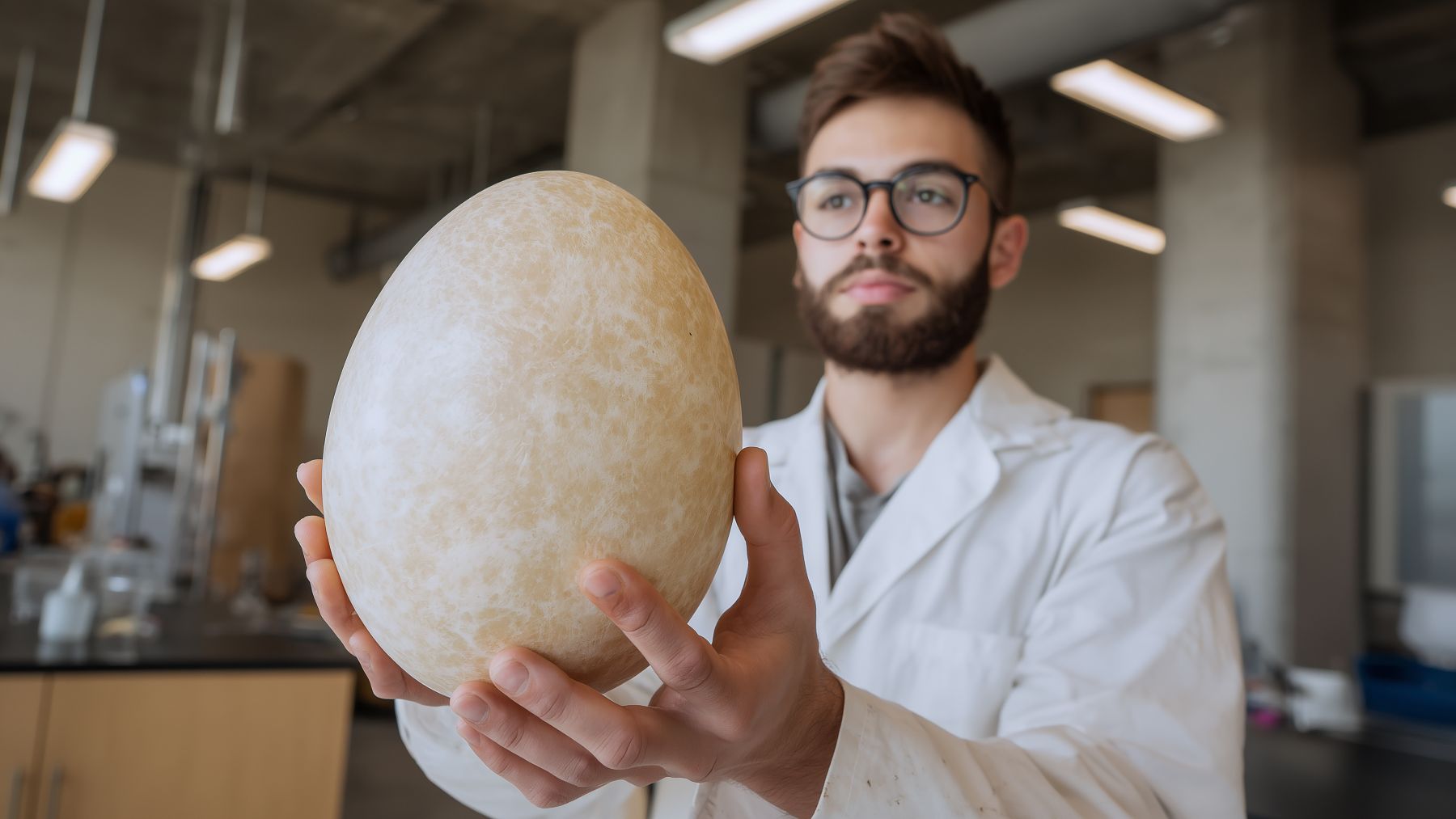
New data on dinosaurs revealed. For many years, scientists have been excavating and analyzing fossilized dinosaur eggs in the landscapes of the Qinglongshan site, in the Yunyang Basin in Central China. Now, through a technique called U-Pb dating, which is like looking at a fossil’s hidden atomic clock, researchers have been able to determine a more precise age that coincides with the Late Cretaceous, about 85 million years ago.
Traditional techniques were inaccurate, and dating these remains with certainty seemed an impossible task
Until very recently, no one knew exactly when these remains had been placed there. Traditional techniques were inaccurate, and dating these remains with certainty seemed an impossible task, so the new data exponentially expands the information we had about dinosaurs. In any case, the work was not easy; unlike other paleontological remains, such as bones or teeth, eggs rarely contain material suitable for conventional radiometric testing.
This is the first time that dinosaur eggs have been dated using uranium-lead carbonate (U-Pb) dating
To date the “age” of dinosaurs, with the tools scientists had, paleontologists had to settle for dating layers of volcanic ash or surrounding rocks, a useful approximation but with excessively wide margins of error. Now, this is the first time that dinosaur eggs have been dated using uranium-lead carbonate (U-Pb) dating. The team published their results in Frontiers in Earth Science.
Chinese researchers have managed to determine the exact age of the eggs using their shells
This discovery provides insights that can help us understand how dinosaurs lived. The ability to date eggs directly and accurately (even though the sediments surrounding them are not particularly radioactive) offers a unique insight into the past. Chinese researchers, led by the Hubei Institute of Geosciences, have managed to determine the exact age of the eggs using their shells. “We showed that these dinosaur eggs were laid approximately 85 million years ago, in the Late Cretaceous,” said Dr. Bi Zhao, corresponding author and researcher at the Hubei Institute of Geosciences.
“We provide the first solid chronological constraints on these fossils, resolving long-standing uncertainties about their age”
With the new method, scientists focused on what was inside rather than external materials—the calcite crystals formed during the fossilization process. “We provide the first solid chronological constraints on these fossils, resolving long-standing uncertainties about their age,” said Dr. Bi Zhao. The Late Cretaceous spanned from about 100 million years ago to about 66 million years ago, until an asteroid ended the reptilian reign of the dinosaurs. Such devastating historical events have led to us knowing so little about this fascinating species.
Did all the dinosaurs disappear at once?
The method involves a laser, using laser ablation and inductively coupled plasma mass spectrometry. Thus, the dated eggs belong to the species Placoolithus tumiaolingensis, of the Dendroolithidae family, a group known for its extremely porous shells. This era is a period of extreme diversity and abundance of dinosaurs, and although it is very well studied in marine records, terrestrial records remain patchy. The Cretaceous was an era of extreme environmental change, from warm climates to inland seas, which led to truly explosive biological diversity and mass extinction events.
With this discovery, some of the biggest questions may finally be answered. Did all the dinosaurs disappear at once? This is one of those obvious questions that still remains unanswered, despite years and years of research into these creatures. It’s also important to know if there were any survivors and what role climate really played in the development of planet Earth’s “giants.” “Our achievement has important implications for research on the evolution and extinction of dinosaurs, as well as on environmental changes on Earth during the Late Cretaceous,” Zhao said.




