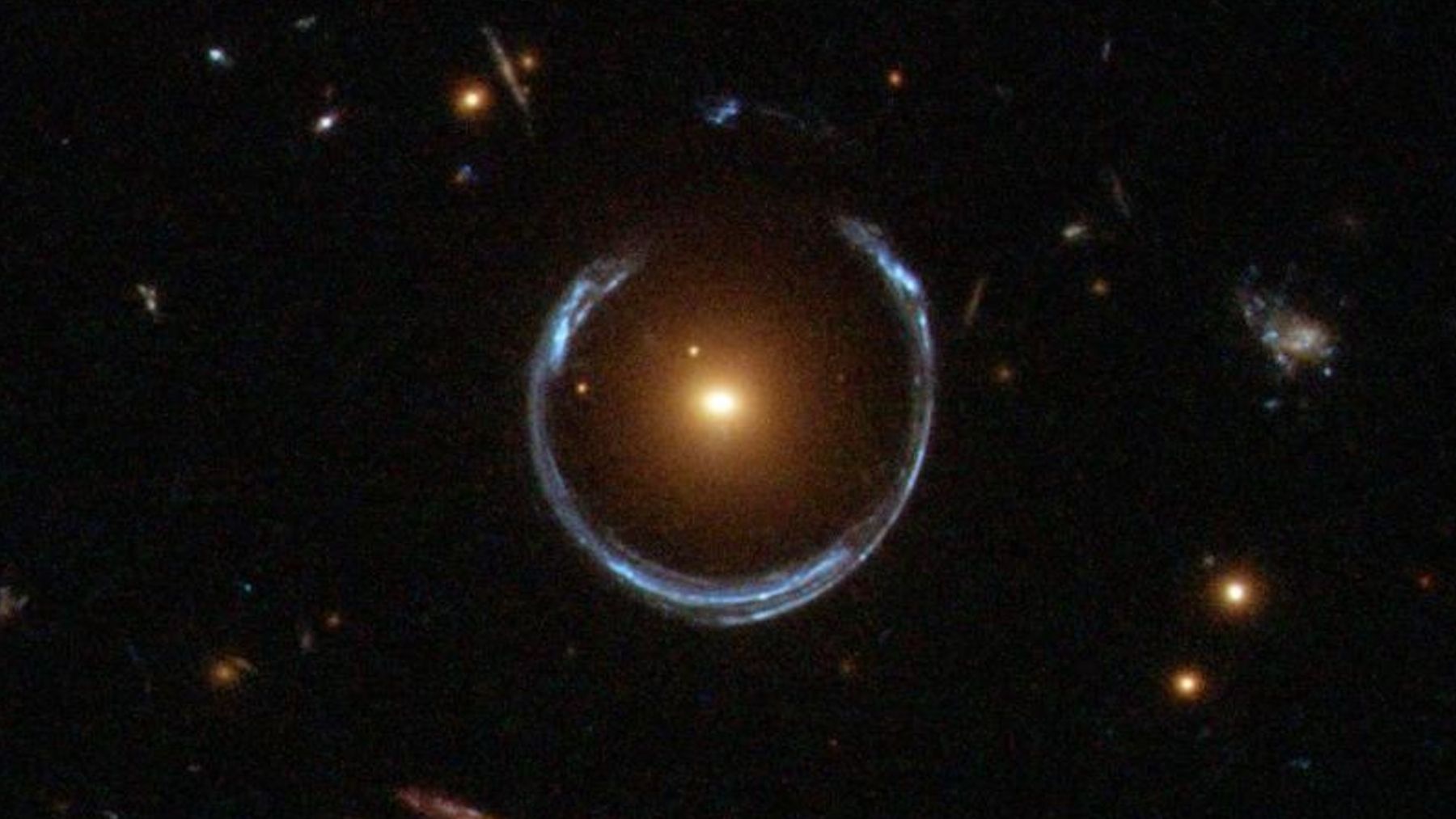
ORCs represent a new morphological class of extragalactic objects characterized by their ring-like appearance in the radius range. There are no signals in other spectra, which makes it difficult to understand their nature. What is known is that they are often associated with massive elliptical galaxies, many of which show evidence of past nuclear activity.
To date, only about a dozen have been confirmed. Most have diameters on the order of hundreds of kiloparsecs, which is equivalent to several million light-years. The fact that they are so rare and that their formation mechanisms are unclear makes them one of the most striking mysteries in radio astronomy today.
The ORC now being studied is located in the galaxy WISEA J035609.67–421603.5, at a redshift of 0.494, i.e., at a distance of billions of light-years. Its size makes it a true cosmic colossus, comparable to several times the diameter of the Milky Way.
The discovery and its characteristics
The object was detected almost by chance in October 2023 during observations with the MeerKAT radio telescope. Shortly afterwards, ASKAP confirmed the presence of the double ring. What is striking is its almost perfect symmetry and the absence of internal substructures.
The researchers’ analysis shows that each ring emits synchrotron radiation, produced by relativistic electrons moving within a magnetic field. The spectra are pronounced: -1.18 and -1.12, respectively. In addition, polarization intensities of 20 to 30% were measured, confirming that the origin is non-thermal.
The authors note that “the integrated flux intensities of the rings are 4.07 and 2.82 mJy at 943 MHz, and 2.77 and 1.98 mJy at 1.28 GHz.” In simple terms, these figures indicate how much radio energy reaches the telescopes from each ring. The important thing is not the numbers themselves, but that they show that the object maintains a constant and consistent emission, ruling out the possibility that it is a transient phenomenon or an instrumental fluctuation.
Clues about their origin
There are several hypotheses to explain what ORCs are. One of the most debated is that they are formed from colossal shock waves generated by star formation bursts or even galaxy mergers. In this scenario, the ring would be the trace of matter violently displaced into the intergalactic medium.
Another possibility is that they are remnants of ancient active galactic nuclei (AGNs). When a supermassive black hole goes through a phase of intense activity, it ejects jets of plasma that extend over hundreds of thousands of light-years. If that activity ceases, the remnants can take on the appearance of bright lobes or rings in radio waves. In the words of the authors, “the double-lobe morphology and polarization characteristics are best explained by the relict emission of previous AGN activity or by jet-driven flows.”
The fact that the object shows two concentric rings reinforces this second idea. Material ejected at different stages in the life of the central black hole could have formed successive structures.
The galactic environment
Another key aspect is that ORC J0356–4216 is not isolated. Analysis of its environment reveals an excess of galaxies in the same region and with similar redshifts. This suggests that it is located in a dense environment, such as an interacting group or cluster. Such a context would favor both galactic collisions and intermittent nuclear activity.
The researchers calculated that the galaxy hosting this ring has an enormous stellar mass, about 400 billion times that of the Sun. This value, expressed in the paper as log(M) ≈ 11.66*, coincides with what has been seen in other galaxies with ORCs. In simple terms, all these structures appear in giant, old, elliptical galaxies, suggesting that they are part of a specific phase in the evolution of these systems and not an isolated case.
A statistical rarity
Researchers estimate that, based on available data, the numerical density of these objects is extremely low: barely two per cubic gigaparsec. This means that they are much less common than spiral galaxies or massive clusters. In addition, observational bias is significant: ORCs that are more regular, symmetrical, and bright are more easily detected. It is possible that there are others with irregular morphologies that go unnoticed in current catalogs.
This point opens up an interesting debate: are ORCs an exceptional phenomenon or, in reality, a common process that we do not yet know how to identify well? The answer will depend on future large-scale surveys with instruments such as the Square Kilometre Array (SKA).
What are the next steps?
Although the exact origin of ORCs remains unresolved, the case of ORC J0356–4216 represents a crucial step forward. The study shows that the polarization properties and symmetry of the double ring are best explained by past activity of a supermassive black hole. However, the possibility that it is a large-scale shock wave produced by galaxy interactions has not been completely ruled out.
To reach a definitive conclusion, observations across a wider frequency range will be needed, as well as optical and spectroscopic analyses of the host galaxy. Each new ORC detected will add pieces to this cosmic puzzle.