
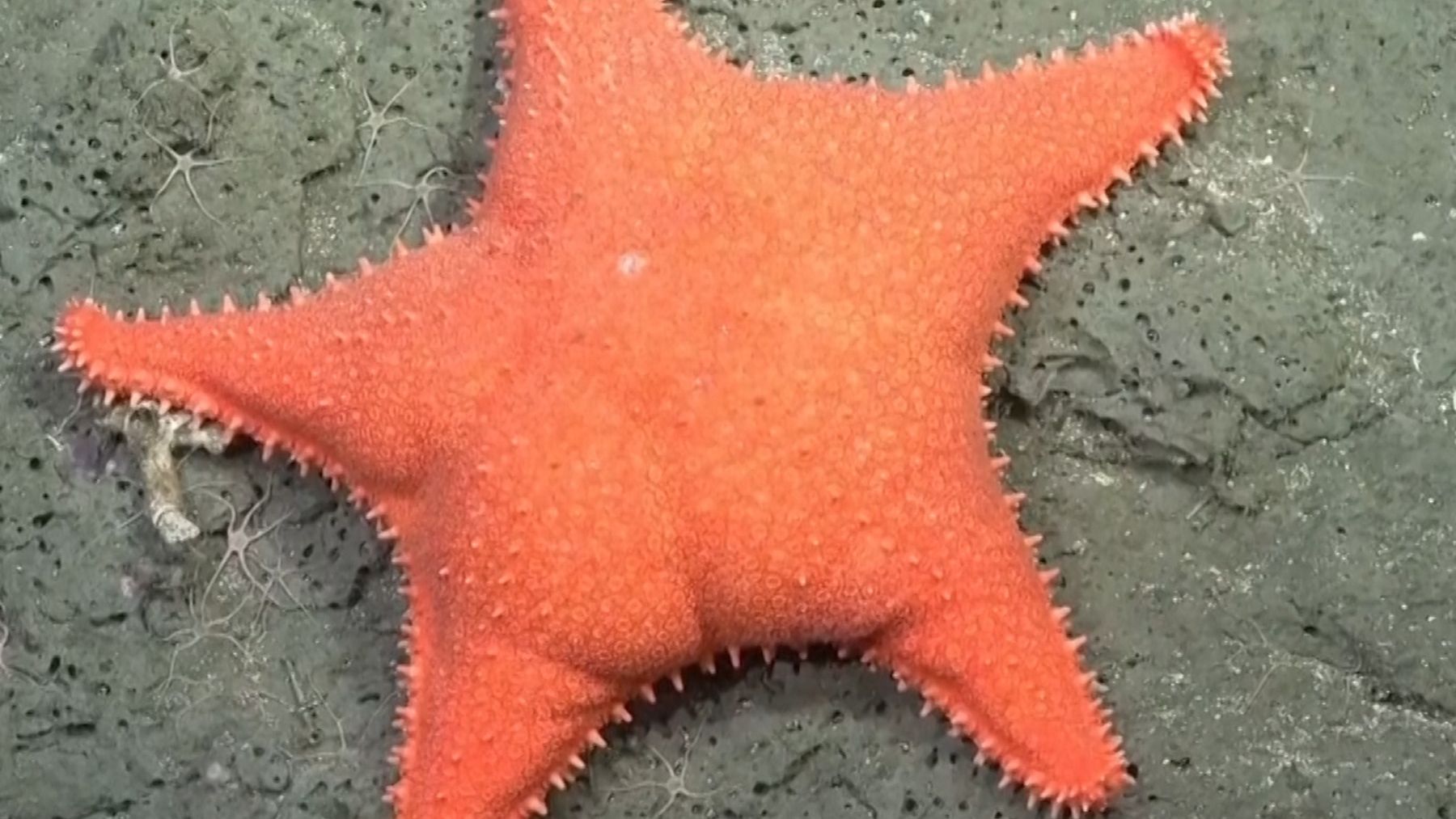
A few days ago, a live broadcast from southern Argentina surfaced, revealing images of the seabed never before seen. In the depths, researchers have discovered a starfish with such a peculiar shape that it has raised eyebrows in laboratories and on social media. The reason? Its uncanny resemblance to the character from SpongeBob.
ROV SuBastian, the robotic vehicle that explored the Mar del Plata underwater canyon
The broadcast was made possible thanks to the live broadcast from the ROV SuBastian, the robotic vehicle that explored the Mar del Plata underwater canyon. Upon discovering the starfish, social media quickly exploded. It’s a member of the Hippasteria family, with a bulky body and short arms, its silhouette reminiscent of a cartoon.
The voyage takes place aboard the research vessel Falkor (too), equipped with state-of-the-art oceanographic equipment. The campaign is broadcast live on the Schmidt Ocean Institute’s YouTube channel, with images captured from depths of up to 3,900 meters.
One of the objectives of this voyage is to show the public something never before seen, something that would otherwise only be seen by scientists. Researchers from the National Scientific and Technical Research Council (CONICET) are conducting the expedition “Underwater Oases of the Mar del Plata Canyon: Continental Slope IV,” in collaboration with the Schmidt Ocean Institute Foundation. The campaign explores the Mar del Plata submarine canyon, a highly biodiverse but little-explored region in the South Atlantic.
The mission has support from the Council and international funding and represents an unprecedented technological and scientific leap
This is an ambitious project, both to find creatures “new” to humans and to allow a viewer from their living room to observe them live. The mission has support from the Council and international funding and represents an unprecedented technological and scientific leap: it is the first time that the remotely operated vehicle (ROV) SuBastian, capable of capturing ultra-high-definition underwater images and collecting samples without disturbing the environment, has been used in Argentine waters in the Southwest Atlantic.
The investigation “has the active participation of fellows, technicians and young researchers”
Regarding the group of researchers leading this expedition, “It has the active participation of fellows, technicians and young researchers, and addresses the exploration of vulnerable marine habitats, detecting human impacts, including marine debris and microplastics, benthic biodiversity (invertebrates and fish), reproduction and biogeography of deep-sea species, environmental DNA, blue carbon and sediment dynamics,” says Daniel Lauretta, CONICET researcher at MACN and Chief Scientist of the expedition.
During the expedition, carnivorous sponges that trap small prey with their filaments
The discoveries are fundamental to understanding the biological richness of the ocean floor. Each new species found represents a piece in the puzzle of deep-sea ecosystems, which play a crucial role in the health of the planet by participating in processes such as the carbon cycle and climate regulation. During the expedition, carnivorous sponges that trap small prey with their filaments, deep-sea fish with nearly transparent bodies that reveal their internal organs, and invertebrates capable of surviving where temperatures are close to zero degrees were identified.
“It’s as if we had a submarine with super-sensitive eyes that goes down for us”
Having the ROV SuBastian is a luxury because it allows us to see live what’s happening at almost 4,000 meters deep, with minimal impact on the organisms. “It’s as if we had a submarine with super-sensitive eyes that goes down for us and shows us everything in great detail,” says Lauretta, referring to the ROV SuBastian.
The South Atlantic, despite its ecological importance, has been less studied than other oceanic regions. This makes each dive a truly pioneering exploration, almost like an underwater space mission.




