
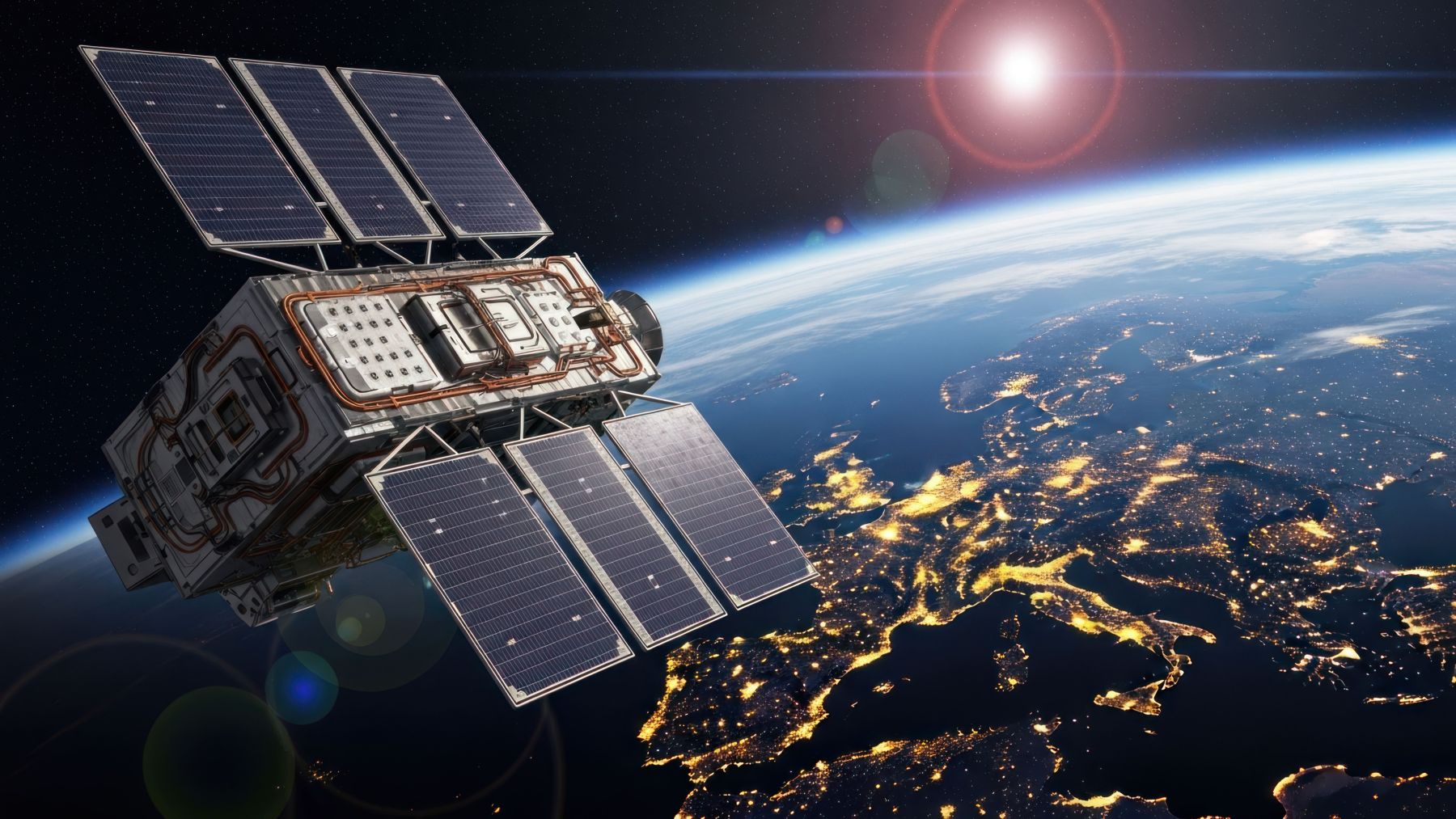
Generating solar energy from space. This is the future many scientists see in the development of renewable energies. Being able to harness the sun’s immense energy to our advantage would be a major breakthrough, although the challenge is obviously enormous. Known as Space-Based Solar Power (SBSP), this innovative technology has sparked a global race involving China, Japan, the United States, and Europe. Also worth mentioning in this regard is CASSIOPeiA, a satellite specifically designed to capture solar energy in space and project it back to Earth.
The best thing about its solar panels is that they are designed to operate day or night
CASSIOPeiA (Constant Aperture Solid-State Integrated Orbital Phased Array) offers 13 times more power than traditional solar panels on Earth. The best thing about its solar panels is that they are designed to operate day or night, in any weather and atmospheric conditions. As we can see, these are solar panels in the solar system. This solar satellite uses high-efficiency reflectors to continuously capture and redirect solar energy. Its main feature is wireless power transmission, which allows the safe transfer of the captured energy to Earth, even in adverse weather conditions. In other words, the goal is to be able to capture light regardless of the condition of the system at any given time.
On the other hand, it’s worth noting that NASA, as part of the ARMADAS (Automated Reconfigurable Mission Adaptive Digital Assembly Systems) system, is already testing autonomous assembly robots to build giant antennas, solar panels, and habitats on the Moon. In 2024, they managed to erect a shelter the size of a shed without detailed human supervision. For Ali Hajimiri, professor of Electrical Engineering at Caltech: “On average, you get eight times more energy in space than you do with solar energy on Earth.” Experts are beginning to take a position on this issue, although in this case, Hajimiri has been researching this field for some time.
The success of CASSiDi represents a revolution in the global energy sector
One of the most concerning factors is how to transport the energy that could be created in space back to Earth. Regarding the challenges of transporting and deploying space solar energy, Caltech’s MAPLE (Microwave Array for Power-transfer Low-orbit Experiment) demonstrated in 2023 the feasibility of sending 1 kW of power 50 meters away with 60% efficiency. In this regard, the CASSiDi (CASSIOPeiA Design Integration) project, an eight-month initiative with a budget of £1.7 million, was also recently validated. The project addressed key ideas such as space assembly and power-to-mass ratios, and offered the possibility of making a space-to-Earth solar farm a reality.
The success of CASSiDi represents a revolution in the global energy sector, and having commercial solar farms within reach demonstrates that the technology justifies government investment. According to the UK Space Agency, Dr. Mamatha Maheshwarappa emphasized the importance of harnessing solar energy in space. Furthermore, given the tremendous competition currently existing among the world’s major powers to lead the search for an energy source that is as powerful as it is sustainable.
Space has always been a source of contention between the United States, China, Russia, and Japan, primarily. In fact, the country governed by Donald Trump recently announced its intention to launch a manned spacecraft from space to orbit the moon. This is expected to happen in 2026, all within the plans of other countries to land a manned spacecraft on the moon. In short, the race to achieve greater advances in everything related to space continues. Now, according to official information, the energy obtained from outside will be transmitted wirelessly without interruptions, and perhaps we will be able to harness solar energy for future generations. This project is based on the progress of the first nighttime solar panel presented to the world. So we will have to keep an eye on how this promising technology develops.




