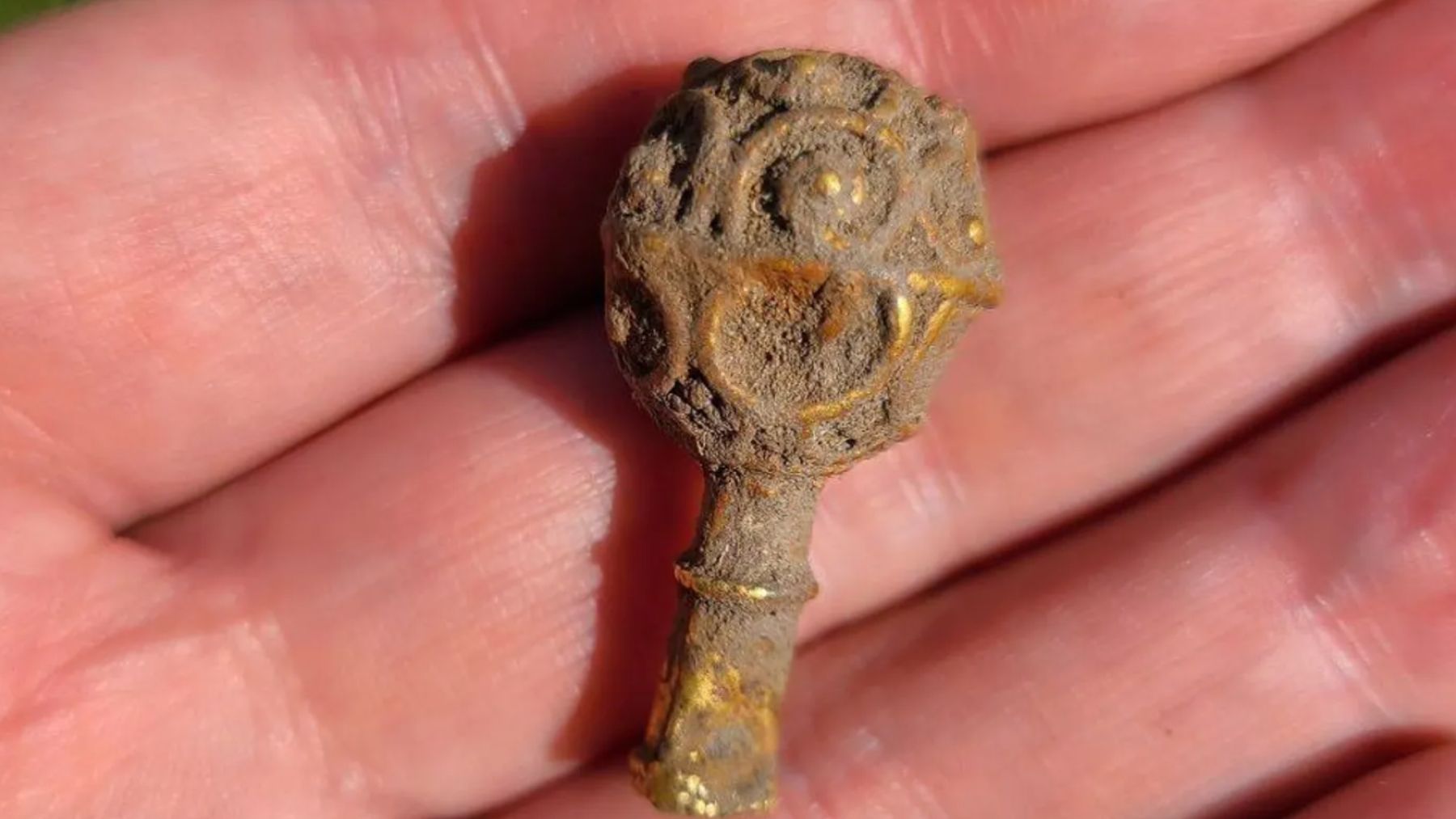
Archaeologists know they can go years and years without finding anything new on a dig, but that’s not the case for Yara Souza. The exchange student from Orlando, Florida, has found a small gold object dating back to the Early Middle Ages. The 21-year-old discovered this object in July 2025 during work organized by Newcastle University at a recent excavation in Redesdale, Northumberland.
“A great example of how metal detectorist and archaeologists can come together to add to our understanding of Northumberland’s past”
Andrew Agate, the Portable Antiquities Scheme’s finds liaison officer for North East England, said the project is “a great example of how metal detectorist and archaeologists can come together to add to our understanding of Northumberland’s past.” And, according to experts, because gold was reserved for the elite, the objects could have had ceremonial or religious uses, especially since the Dere Street route connected important religious centers such as Jedburgh and Hexham.
Both the 2021 find and the current one have been identified as ball-headed pins, dated to between 800 and 1000 AD
The object found is almost identical, though slightly larger, to a similar artifact discovered in 2021 by metal detectorist Alan Gray at the same site. “It was amazing to discover something that hadn’t been seen for more than a thousand years, I was really geeking out over it,” Souza said. Both the 2021 find and the current one have been identified as ball-headed pins, dated to between 800 and 1000 AD.
James Gerrard: “We know that Dere Street remained an important thoroughfare long after the Romans”
This discovery has not only been a source of joy for the young student, but has also rekindled interest in the medieval history of Northumberland (northern England) and highlighted the collaboration between metal detectorists and archaeologists. James Gerrard, professor of Roman Archaeology at Newcastle and director of the excavation, explained: “We know that Dere Street remained an important thoroughfare long after the Romans. It is possible that this pair of objects were deliberately buried.”
Souza: “I couldn’t believe I had found something so quickly on my first dig”
Once the necessary analyses are complete, both artifacts are expected to be put on display at the Great North Museum: Hancock, allowing the public to appreciate not only their artistic and material value, but also their historical significance. The find will be analyzed through the UK’s Portable Antiquities Scheme, which is responsible for recording and studying such pieces. “I couldn’t believe I had found something so quickly on my first dig,” Souza said since the big news.
“Gold was not a casual material in early medieval Britain. It signaled authority, wealth, and often a connection to the church or royal settings”
And let’s remember that it’s not just experts who find great gems from human history; you too can find hidden treasure in your home, as happened to Betty and Robert Fooks, a married couple from the English town of Dorset, when they renovated their home. When lowering the kitchen’s concrete floor to gain more height, the engineer involved in the renovation found a glazed ceramic bowl containing more than a thousand 17th-century coins.
In conclusion, this find continues to write the history of gold objects in the United Kingdom, because as experts say, “Gold was not a casual material in early medieval Britain. It signaled authority, wealth, and often a connection to the church or royal settings where liturgy and status overlapped,” explained specialists from the Portable Antiquities System.