
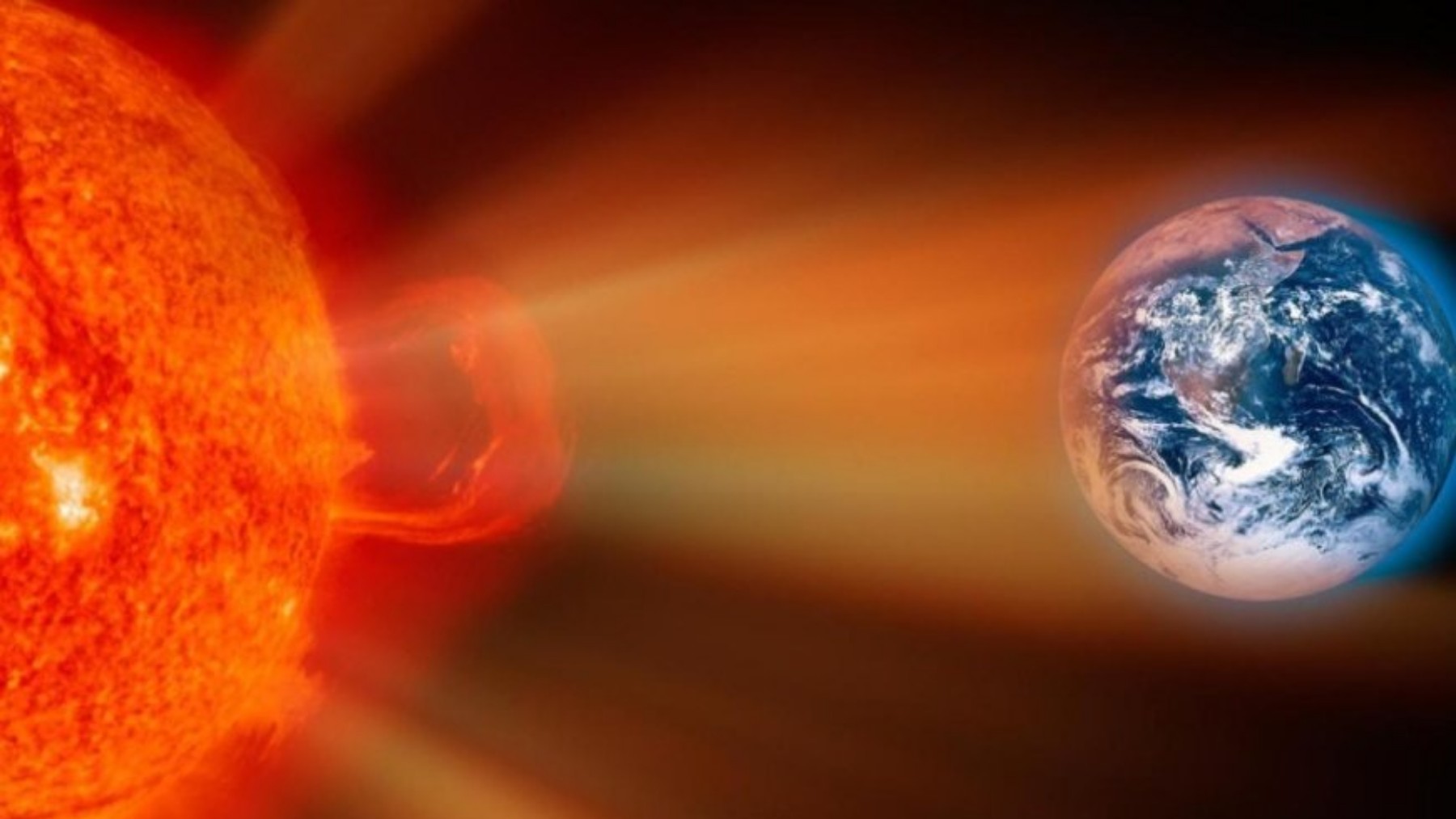
ScienceAlert, a specialist media in space science, has published images captured by NASA related to the latest news about solar activity; a face has been drawn on the surface of the sun. This is called the coronal hole, a region where the magnetic field opens and allows particles to escape. These holes can cause their own weather space, giving rise to solar storms.
Coronal holes
There are so many phenomena occurring in space that it is virtually impossible to keep track. Black holes, supersonic shocks, gamma-ray bursts, meteor showers, and endless events make up an almost endless list. Space, although increasingly known, still harbors mysteries for human knowledge, who probably will not get to decipher them all.In this case, it is a phenomenon already known and previously studied; the coronal holes.
They are defined as the areas of lower temperature and density in the outermost layer of the Sun, where the magnetic field extends towards the interplanetary medium, leaving the holes that we can see. It is not a real hole in the Sun, but in the separation of the magnetic field. What causes this? These “holes” make it easier for the Sun’s particles to escape into space in a burst through the Solar System.
Then Sun´s worried face
Although the Sun seems concerned about what has happened, the reality is that there is nothing to worry about. Two eyes and a wide mouth that seems to scream, is what we can see on the surface of the celestial body. What has called attention to part of its apparent expressiveness, is the size of the coronal holes that make up the eyes in the northern zone of the star; these are two holes the size of Jupiter!
How will it affect the Earth?
Fortunately, although the news seems alarming, there is nothing to worry about. Not only because the appearance of coronal holes on the surfaces of stars is normal, but because those that have originated in the Sun are harmless. It is true that these holes blow wind out into the Solar System, generating geomagnetic storms when particles collide with the magnetosphere of another body, in this case Earth. This eruption of particles bound together by magnetic re-conexion occurs in areas where the magnetic field is most powerful. However, this time there is nothing to worry about, because this hole can not produce even a small geomagnetic storm (maybe that’s why it is not happy).
Can you see it with the naked eye?
The answer to that question is no. Observing the sun in optical wavelengths without a professional team is not recommended, as it could have consequences on your eyesight. Also, without proper tools and equipment, you won’t be able to appreciate anything. However, if you look with ultraviolet light, you will be able to see dark spots in the Sun, because they are more mature and less dense regions than the rest of the plasma around them.
Any other surprise?
The British Met Office advised that this magnetic separation may generate a period of high winds, but given the characteristics of the hole and its weak interaction because it is located in the southern zone of the Sun, they give a very low probability. Storms caused by the activity of coronal mass flares and ejecta on our planet are much more common than we think. In fact, the northern lights that bathed our skies were the consensus of it.
There is therefore no danger in sight. Coronary holes are usually harmless. What has attracted the most attention was the drawing on the solar surface, beyond the possible danger of it. We will see if this is the last work that makes the Sun or if it will not delight with other designs again!
Discover that other forces in space can impact the Earth, here.




