
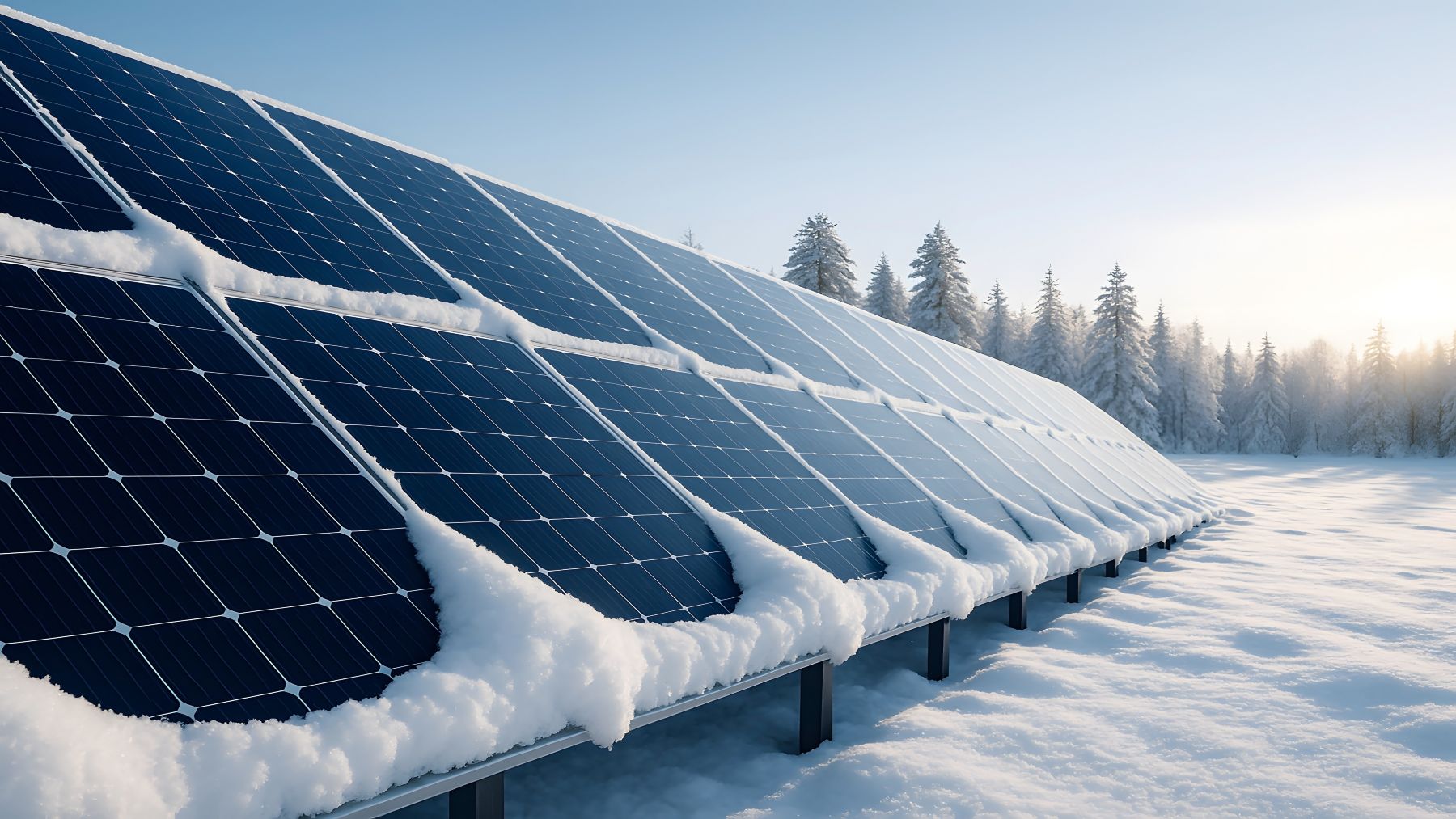
Switzerland is transforming the Alps into a giant solar power plant—that’s the big news. Three years ago, the Swiss Parliament passed a law simplifying the construction of large Alpine solar parks (in the canton of Graubünden), offering 60% subsidies to those who manage to generate electricity before the end of the year. Faced with the advance of climate change and the urgent need to reduce emissions, the country is betting on a clean and inexhaustible energy source that promises to change the course of the energy transition. We’ll go into more detail later, but the total cost is around $100 million and is being financed by Alpine Energy and the company Aventron.
The installation costs 85 million Swiss francs
The park will have a total of 5,700 solar panels that will supply electricity to 6,500 homes in the canton of Graubünden. The project, supported by the federal Solar Express program, aims to harness the altitude and solar radiation of the Alps to generate electricity even in winter, when demand increases and the lower areas are shrouded in fog. According to official figures, the installation, which cost 85 million Swiss francs (90.3 million euros), will have a production capacity equivalent to almost ten times the amount produced by the Muttsee Dam solar plant, currently the largest in the Swiss Alps. The challenge is enormous, but so is the potential of this mountainous region, where energy rises with the sun, given that the area is located at an altitude of 2,200 meters.
Expectations are enormous; in fact, the Swiss government anticipates that around half of the electricity generated by the new facility will be produced in winter, when demand is high and supply is lowest. This pioneering project symbolizes a paradigm shift, as the energy comes directly from natural ecosystems, not by destroying them, but by integrating with them. It is the first project launched by Swiss authorities following the passage two years ago of a federal law to accelerate the construction of solar farms in the country’s mountainous regions. With the passage of this law, the aim is to offer subsidies to finance up to 60% of the costs.
Since the government announced its intentions, the state has been inundated with projects
The idea is that the Sedrun solar park will have 5,700 panels spread across 300,000 square meters. It is estimated to reach a capacity of 19.3 megawatts, as mentioned above. The project must be fully completed by 2025, when, according to regulations, operators must begin feeding electricity into the grid to avoid losing state funding. The total cost is around $100 million and is financed by Alpine Energy and Aventron. It’s worth noting that since the government announced its intentions, the state has been inundated with projects, making its successful implementation paramount.
The plant’s high winter production coincides with the increased electricity demand during this period
This facility will supply energy to approximately 6,500 homes, with one key feature: almost half of its production will be concentrated in the coldest months of the year. Its location allows it to benefit from unique conditions, favoring efficient energy production year-round. The combination of snow, altitude, and solar radiation results in greater efficiency than panels installed in lower-lying areas. The plant’s high winter production coincides with the increased electricity demand during this period, meaning that this European country requires significantly greater renewable energy production capacity during the colder months.
In any case, precisely because of the location, the transport logistics, the extreme conditions, and the need to protect the alpine flora, meticulous planning is essential for projects of this nature. This does not negate the fact that the construction of this solar plant at such a high altitude represents a significant step forward for Switzerland in maximizing renewable energy generation. To counteract potential geological incidents, engineers developed structures resistant to avalanches and thermal variations, minimizing the visual and environmental impact. Thus, Switzerland’s path toward renewable energy continues to advance.




