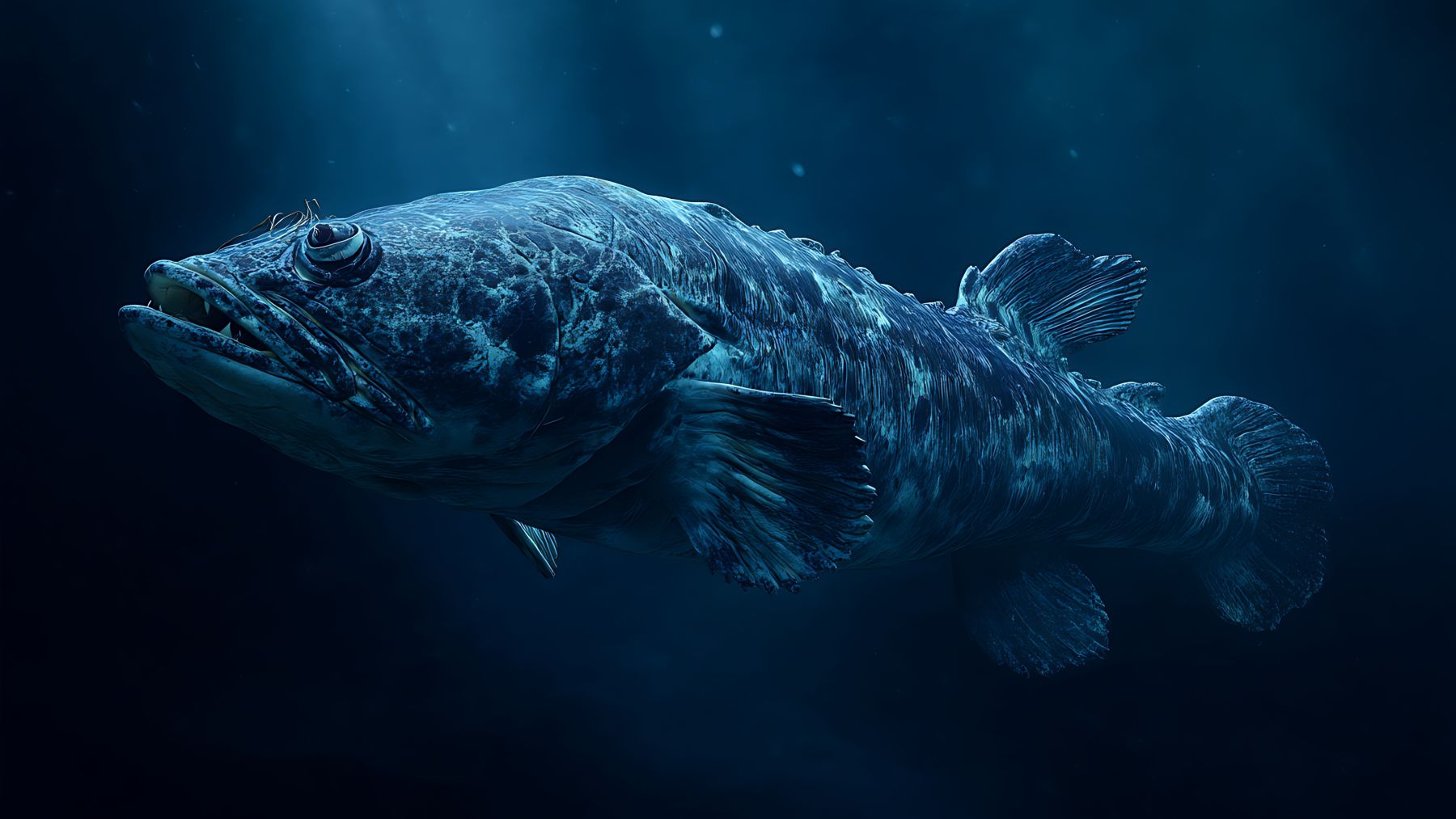
Sometimes humans are guilty of being narcissistic. The reality is that we’re a species that hasn’t been around for that long compared to other species. There are animals that appeared almost a billion years ago. This is the case with coelacanths, fish that could easily pass for real fish. But the fact is that they have a peculiarity: they appeared in the Devonian period about 400 million years ago, and many fossilized remains dating back 350 million years have been found.
This fish belongs to the Sarcopterygian family and was a lobe-finned fish
Before the rediscovery of the coelacanth in 1938, researchers assumed it had become extinct at the end of the Cretaceous period, 65-70 million years ago. This fish belongs to the Sarcopterygian family and was a lobe-finned fish. Indeed, it had many fins, the lower ones being remarkably long and thick. That year, when the first specimen arrived, Marjorie Courtenay-Latimer, curator of the East London Museum, realized it was a special specimen. She couldn’t identify it, so she stuffed it so someone could investigate it further.
The second coelacanth was found in 1952 by two fishermen of the Comoro Islands
Furthermore, a second specimen wasn’t discovered for another 15 years. The second coelacanth was found in 1952 by two fishermen of the Comoro Islands, a small island chain nestled in between Madagascar and mainland Africa. The coelacanth is an example of a “Lazarus taxon,” an animal that apparently disappears from the fossil record only to be rediscovered in its same form millions of years later.
Indonesian coelacanth, or Latimeria menadoensi: It became known that this species is not only found in South Africa
Thus, as it stands today, coelacanths fall into one of two species: the West Indian Ocean coelacanth (Latimeria chalumnae), primarily found near the Comoro Islands off the east coast of Africa, and the Indonesian coelacanth (Latimeria menadoensis). The National Geographic Society, with support from the German magazine Geo, funded an expedition that allowed the first underwater images of the coelacanth to be taken in its natural environment. This occurred in 1987, and over the years, we have seen more and more fish from this family. Thus, it became known that this species is not only found in South Africa; there is also the Indonesian coelacanth, or Latimeria menadoensis, as mentioned above. These live in the Indian Ocean at great depths, and this is curious, since they reflect an evolutionary divergence similar to that between humans and chimpanzees.
Coelacanths have a number of unique physiological traits that have served them well for millions of years
According to scientists, these may be some of the reasons why the ancient coelacanth has been able to withstand the test of time. Coelacanths have a number of unique physiological traits that have served them well for millions of years. Furthermore, they have thrived in stable environments, as coelacanths inhabit deep, stable environments, such as underwater caves and the deep sea, which have not changed much over geological time.
Coelacanths are part of an ecological niche, typically found in deep, cold waters, which hasn’t changed much
On the other hand, coelacanths have a relatively low metabolic rate, which allows them to survive in environments where food may be scarce. This is very important because food depends on suitable ecosystems, so even if there is a shortage, coelacanths can survive longer than other species. Furthermore, they are part of an ecological niche, typically found in deep, cold waters, which hasn’t changed much. This stability in their habitat means they have faced less pressure to adapt compared to species that live in more variable environments. Given all this data, we can understand why this fish has been able to survive for so many years.