
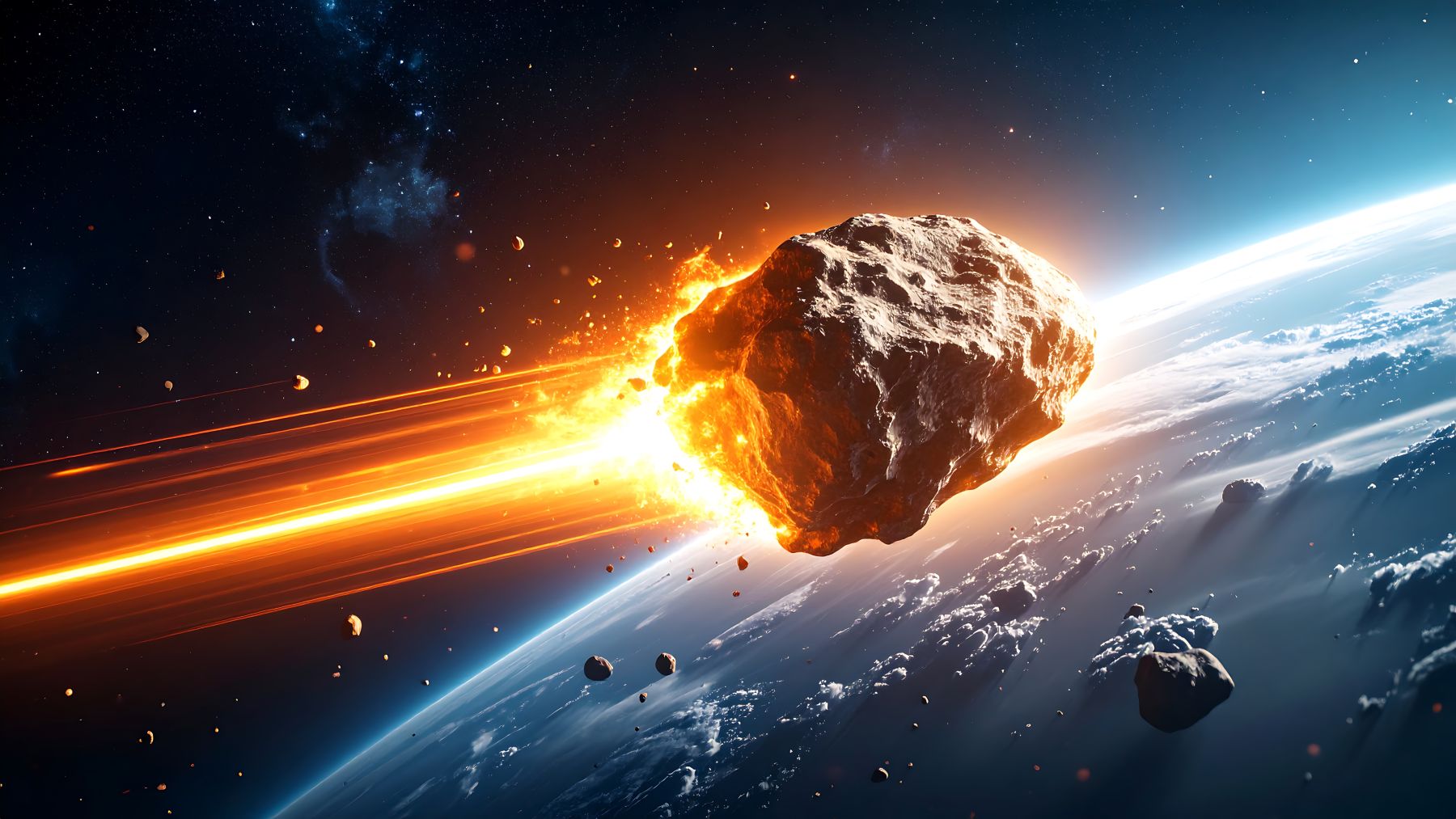
It’s not crazy to think that an asteroid could hit Earth. Science shows that the probability of such an impact occurring is greater than the probability of a person being struck by lightning or attacked by a coyote in their lifetime. This is the conclusion reached by researcher Carrie Nugent’s team in a study published in The Planetary Science Journal.
The possible impact of an asteroid is a phenomenon that can be prevented
Science tells us it’s not about thinking an asteroid might hit tomorrow; it’s about understanding the probabilities of the universe we live in. Humans are typically unaware of what’s happening in the Galaxy, but the movement up there is continuous. NASA’s DART mission demonstrated in 2022 that a spacecraft can modify an asteroid’s trajectory, deflecting it just enough to avoid a collision.
Therefore, the possible impact of an asteroid is a phenomenon that, with study and scientific assistance, can be prevented. The results of the research indicate that “an asteroid impact is unique among natural disasters; it is the only one that is, theoretically, technologically preventable.”
Asteroid impact: It’s greater than the probability of dying from a collapsed hole in dry sand on a beach
On the one hand, according to the study, the probability of being struck by a NEO greater than 140 meters is greater than that of a person in the United States being struck by lightning or attacked by a coyote in their lifetime. It’s also greater than the probability of dying from a collapsed hole in dry sand on a beach. On the other hand, it’s much lower than the probability of being in a car accident or contracting the seasonal flu. These are the facts.
Carrie Nugent, an associate professor at Olin College, publishes on her website all the details about how to prepare to prevent an event of this proportions. An asteroid impact is the only natural disaster we have the technology to prevent. But to prevent an impact, we’d need time–ideally decades– to prepare. Therefore, we must discover all of the potentially hazardous near-Earth objects now.” says the expert.
Let’s get to the theory. The researchers simulated an ensemble of five million orbits of near-Earth objects (NEOs) with diameters greater than 140 meters, using the NEOMOD2 population model and the JPL Horizons ephemeris system. Of that total, only three objects impacted in the model, yielding an impact probability per object of 4 × 10⁻⁹ per year. Using estimates of the actual number of NEOs in that category, the team calculated that an impact could occur approximately every 11,000 years.
Although the figure may seem low, the importance of the study is enormous. “I work with physics and astronomy students to model the physical properties and evolution of these bodies, and I work with engineering students to develop software (such as FindPOTATOs) that enables other researchers and citizen scientists to study asteroids and comets,” says Nunget on her website.
In any case, the studies don’t focus on the probability of an individual being killed by an asteroid, but rather on the probability of an impact occurring anywhere on the planet during a given year. This is the point that interests researchers, who ultimately dedicate themselves to trying to achieve the common good, to finding tools that will help the entire planet.
Finally, the expert explains in his study that “We have very limited information on interstellar objects from the two known objects in this population. The Vera Rubin Observatory Legacy Survey of Space and Time may shed light on this issue by discovering more interstellar objects, which may allow for the risk from these objects to be evaluated” and goes “To enable a precise calculation of the risk from near-Earth comets, there is value in prioritizing the study and discovery of long-period comets, towards creating a comprehensive cometary. population model.”




