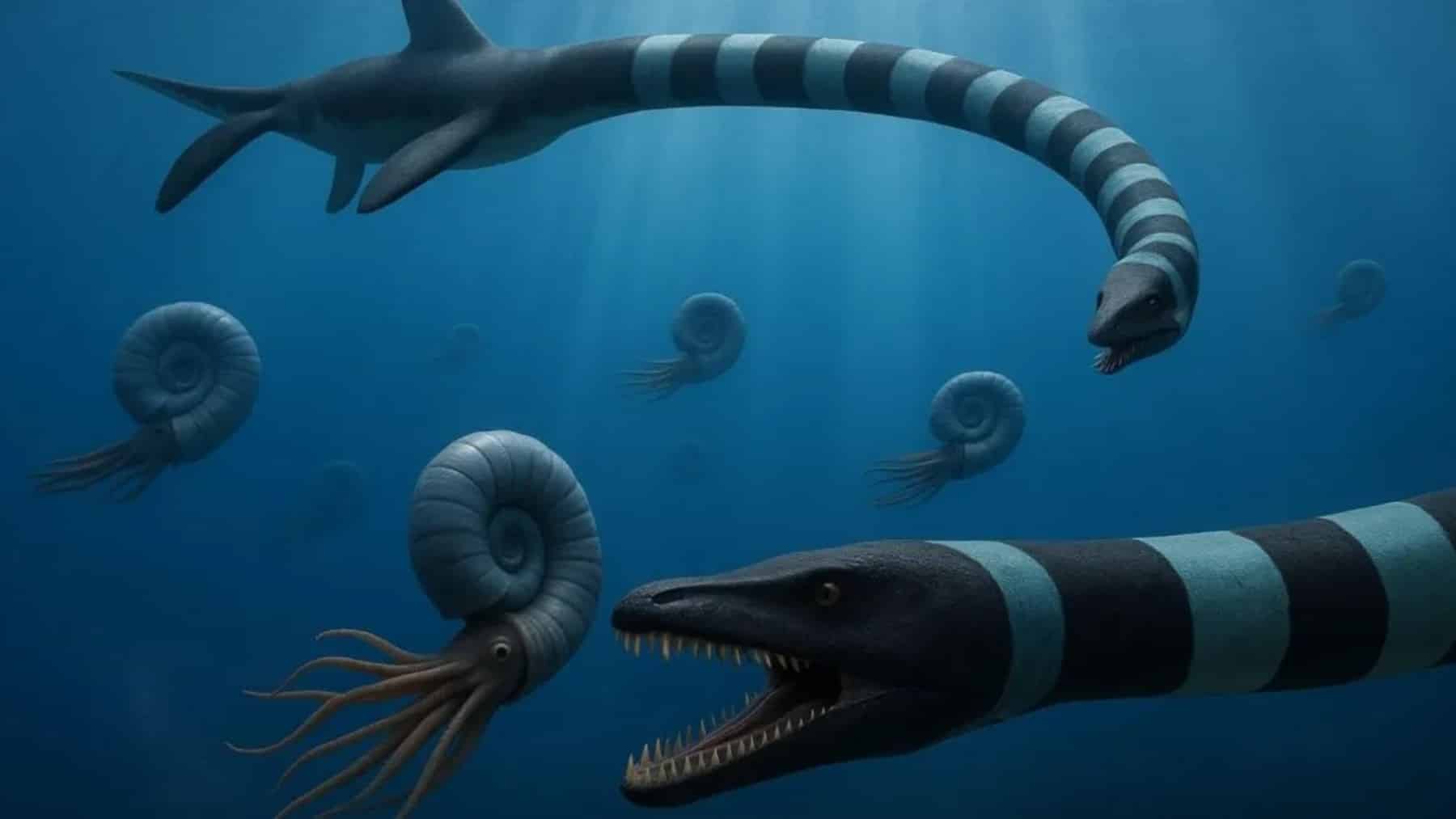
After decades, paleontologists have been able to name a number of fossils found on the banks of the Puntledge River that date back 85 billion years; Traskasaura sandrae. Classified as an elasmosaurus, it is a creature of 12 meters, with capable of smashing shells teeth and a very long neck. Unlike other predators, this one carried out an immersion from the surface thus surprising its prey. After years of bewilderment and having exposed the incomplete remains in the Courtenay Museum, the finding of a young and complete fossil helped the researchers to put an end to this enigma.
A never ending research
Three and seven years ago, in 1988, two amateur paleontologists named Michael and Heather Trask found the first remains while exploring the banks of the Puntledge River, completely by chance. An incomplete skeleton that captures the attention of scientists, but given its state, it is impossible to reach a firm conclusion about its origin and origin. It was therefore decided that the remains should be displayed in the Courtenay Museum – located in British Columbia -, until more light could be shed.
Years later, another fossil was discovered This time it was a young specimen fully preserved, which makes it easy to compare with the first remains found, evidencing that they shared a series of characteristics that are also unic of that species.
Traskasaura sandrae
Teeth that break carapaces, a neck composed of 50 vertebrae, its post-cranial skeleton, and a total length of 12 meters, the creature was named Traskasaura sandrae. Unlike the so-called “aquatic dinosaurs” known until now, this specimen hunted from above, carrying out an immersion from the surface and surprising its prey. The researchers have shown that the main food of the hunter was ammonites, a hard shell and spiral-shaped mollusks, already extinct. All details about this species, of the elasmosaurus family, can be found in a very interesting article published in the Journal of Systematic Paleontology, made by the team of researchers in charge.
The origin of its name
The name chosen for this species has managed to take care of all the details. The first discoverers of fossil remains belonged to the Trask family (root of the name), while “sandrae” responds to the name of a paleontologist very close to the study who died due to cancer, Sandra Lee O Keefe.
F. Robin O Keefe, together with a team of paleontologists from various parts of the world such as Chile, Canada and the United States, led this research that finally saw the light last 22 May 2025. On this occasion, science has wanted to honor the memory of those who have left their mark on research.
British Columbia’s star
This finding has led paleontologists not only to answer questions that had been unanswered for years, but also to trace the evolutionary tree of elasmoraurids.
In 2023, Traskasaura became a local star, receiving the title of “Fosil Provincial” from British Columbia by popular vote. Thus, its cultural importance was enhanced.
The area of the Upper Cretaceous, where the remains of the study were found, is characterized by being particularly prolific in marine skeletons, but the characteristics of the Traskasaura had never been studied.
What does this discovery imply?
This discovery has led researchers to close years of uncertainty, while adding a new species to marine reptiles. It may be thought that the Cretaceous ocean, especially the northern zone, still holds mysteries that far from being fanciful, reveal the number of species that are yet to be discovered.
It is worth mentioning the way in which the investigation started with a family finding unintentional remains, and ended with an international team publishing an article on this finding. It reflects the beauty of paleontology, where cooperation and patience are essential to making great discoveries.
If you want to learn more about things that have been discovered underwater, read the following article!